














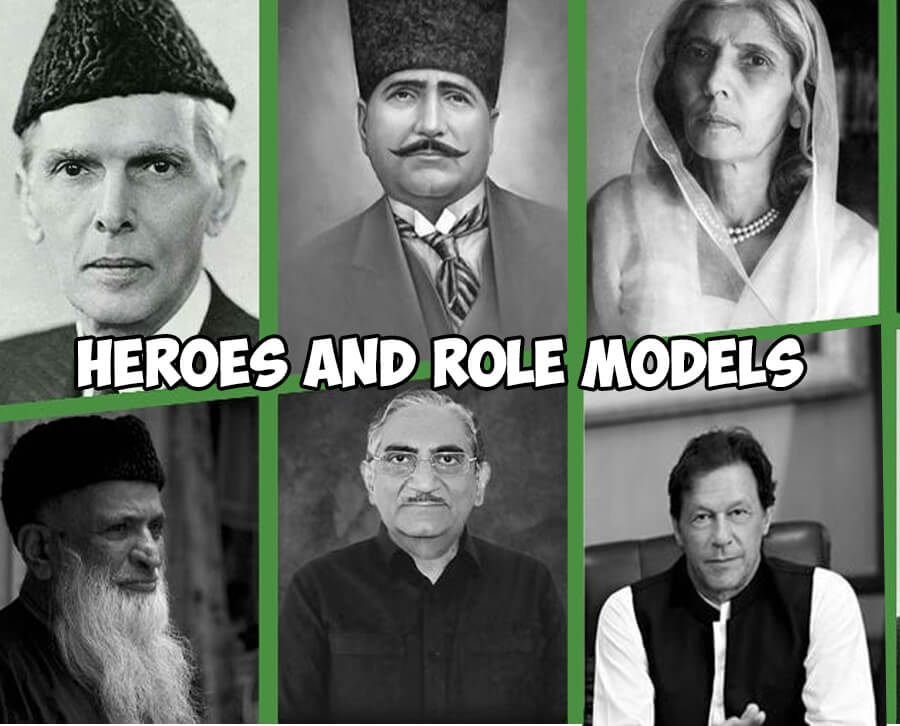
 Pakistan, a nation rich in culture, history, and resilience, has produced numerous heroes and role models who have left an indelible mark on society through their extraordinary achievements and contributions. From the fields of sports and entertainment to politics and academia, these individuals have inspired generations with their passion, determination, and commitment to excellence. In this article, we will shine a spotlight on some of the most iconic heroes and role models that Pakistan has ever seen, celebrating their lives, accomplishments, and enduring legacies.
-
Quaid-e-Azam Muhammad Ali Jinnah:
Quaid-e-Azam Muhammad Ali Jinnah, revered as the Father of the Nation in Pakistan, played a pivotal role in the creation of the world's first Islamic Republic. His leadership, vision, and unwavering commitment to the ideals of democracy and freedom laid the foundation for the birth of Pakistan. In this section, we delve deeper into the life and legacy of Quaid-e-Azam, shedding light on his remarkable contributions and the enduring impact of his leadership.
-
Early Life and Legal Career:
Born on December 25, 1876, in Karachi, British India, Muhammad Ali Jinnah was raised in a prominent mercantile family. He received his early education in Karachi before pursuing higher studies in law in England. Jinnah was called to the bar at Lincoln's Inn in 1896 and embarked on a successful legal career, earning renown for his eloquence, intellect, and commitment to justice.
-
Champion of Muslim Rights:
Throughout his career, Muhammad Ali Jinnah emerged as a staunch advocate for the rights and interests of Muslims in British India. He joined the All-India Muslim League in 1913 and quickly rose through the ranks, becoming a prominent voice for Muslim political empowerment. Jinnah's tireless efforts to safeguard Muslim rights against the backdrop of growing communal tensions laid the groundwork for the demand for a separate Muslim state.
-
The Struggle for Independence:
As the leader of the Muslim League, Muhammad Ali Jinnah played a central role in the struggle for independence from British colonial rule. He famously articulated the Two-Nation Theory, asserting that Hindus and Muslims were distinct nations with divergent religious, cultural, and social identities. Jinnah's insistence on the creation of a separate Muslim state gained momentum in the wake of the Lahore Resolution of 1940, which called for the establishment of independent Muslim-majority provinces in British India.
-
Architect of Pakistan:
Muhammad Ali Jinnah's unwavering commitment to the cause of Muslim nationalism culminated in the creation of Pakistan on August 14, 1947. As the first Governor-General of Pakistan, Jinnah faced formidable challenges in navigating the nascent nation through the tumultuous early years of independence. His visionary leadership, statesmanship, and dedication to democratic principles laid the groundwork for Pakistan's emergence as a sovereign and independent state.
-
Legacy and Vision:
Quaid-e-Azam Muhammad Ali Jinnah's legacy as the founding father of Pakistan endures to this day, serving as a guiding light for generations of Pakistanis. His vision of a democratic, pluralistic, and progressive Pakistan continues to inspire citizens to strive for a better future. Jinnah's principles of unity, faith, and discipline remain foundational to the national ethos, reminding Pakistanis of the sacrifices made to secure their freedom and independence.
-
Allama Muhammad Iqbal:
Allama Muhammad Iqbal, often referred to as the spiritual father of Pakistan, was a visionary poet, philosopher, and political thinker whose ideas ignited the flame of independence in the hearts of millions. His poetry, imbued with a deep sense of spirituality and nationalism, continues to resonate with people across generations, inspiring them to strive for self-discovery, self-empowerment, and societal transformation. In this section, we delve deeper into the life and legacy of Allama Iqbal, shedding light on his profound influence and enduring impact on Pakistani society.
-
Early Life and Education:
Born on November 9, 1877, in Sialkot, British India, Muhammad Iqbal exhibited exceptional intellectual prowess from a young age. He received his early education in Sialkot before pursuing higher studies in Lahore, Cambridge, and Munich. Iqbal's exposure to Western philosophy, literature, and Islamic mysticism profoundly shaped his worldview, laying the foundation for his later intellectual and literary endeavors.
-
The Poet of the East:
Allama Iqbal's poetry stands as a testament to his unparalleled literary genius and spiritual insight. His verses, written in Urdu and Persian, blend elements of Sufism, Islamic mysticism, and social commentary to evoke a sense of spiritual awakening and national consciousness. Iqbal's magnum opus, "Bang-e-Dra" (The Call of the Marching Bell), and "Zabur-e-Ajam" (Persian Psalms) resonate with themes of self-realization, social justice, and the revival of the Muslim ummah.
-
Vision of Muslim Renaissance:
Central to Allama Iqbal's philosophy was the concept of "Khudi" (Selfhood) and "Shaheen" (Eagle), symbolizing the individual's quest for self-discovery and spiritual ascension. Iqbal believed that Muslims could only achieve true greatness and reclaim their lost glory by rekindling the spirit of self-confidence, self-reliance, and self-determination. His famous poetry collections such as "Asrar-e-Khudi" (Secrets of the Self) and "Payam-e-Mashriq" (Message of the East) articulate this vision of Muslim renaissance and revival.
-
Advocate of Muslim Unity:
Allama Iqbal was a fervent advocate of Muslim unity and solidarity in the face of colonial oppression and socio-political upheaval. He played a pivotal role in shaping the political consciousness of Indian Muslims, urging them to transcend sectarian divides and unite under a common banner. Iqbal's famous Allahabad Address in 1930 laid the groundwork for the demand for a separate Muslim state and inspired the creation of Pakistan.
-
Legacy and Inspiration:
Allama Iqbal's enduring legacy as the spiritual guide and intellectual beacon of Pakistan is celebrated and revered to this day. His poetry continues to inspire and uplift millions of Pakistanis, reminding them of their rich cultural heritage, spiritual heritage, and collective destiny. Iqbal's vision of a progressive, enlightened, and dynamic Muslim society remains as relevant today as it was during his lifetime, serving as a guiding light for individuals striving for personal and societal transformation.
-
Abdul Sattar Edhi:
No list of Pakistani heroes would be complete without mentioning Abdul Sattar Edhi, often referred to as the "Angel of Mercy." Born in 1928 in Gujarat, British India (now Pakistan), Edhi dedicated his life to humanitarian work, founding the Edhi Foundation, one of the world's largest and most renowned social welfare organizations. From providing free healthcare and education to sheltering the homeless and rescuing abandoned infants, Edhi's selfless efforts touched the lives of millions across Pakistan and beyond. His unwavering commitment to serving humanity earned him numerous accolades, including the Ramon Magsaysay Award and the Nishan-e-Imtiaz, Pakistan's highest civilian honor.
-
Early Life and Inspiration:
Abdul Sattar Edhi was born in 1928 in the small town of Bantva, Gujarat, British India. Raised in a modest household, Edhi's upbringing instilled in him a deep sense of empathy and compassion for the less fortunate. It was during his formative years that Edhi witnessed firsthand the suffering and poverty endured by the marginalized communities around him, sparking a lifelong commitment to alleviating human suffering.
-
The Birth of the Edhi Foundation:
In 1951, at the age of 23, Abdul Sattar Edhi established the Edhi Foundation with a mission to provide comprehensive social services to the underprivileged and marginalized segments of society. What began as a humble dispensary in Karachi soon grew into a vast network of clinics, shelters, orphanages, and ambulances, serving millions of people across Pakistan. Edhi's vision was simple yet profound: to create a welfare state within a state, where no one would be left behind or neglected.
-
Selfless Service Amidst Adversity:
Throughout his life, Abdul Sattar Edhi remained committed to his principles of selfless service, often at great personal sacrifice. He and his wife, Bilquis Edhi, dedicated their lives to the cause, living frugally and eschewing material wealth in favor of helping others. Edhi was known to personally oversee the operations of his foundation, often working long hours into the night to ensure that every individual in need received the care and assistance they deserved.
-
Legacy and Recognition:
Abdul Sattar Edhi's tireless efforts did not go unnoticed, earning him widespread acclaim and recognition both at home and abroad. He received numerous awards and honors throughout his lifetime, including the Ramon Magsaysay Award for Public Service, the Lenin Peace Prize, and the Nishan-e-Imtiaz, Pakistan's highest civilian honor. Despite his international acclaim, Edhi remained humble and grounded, always emphasizing that his greatest reward was the satisfaction of knowing that he had made a positive difference in the lives of others.
-
The Edhi Foundation Today:
Even after his passing in 2016, Abdul Sattar Edhi's legacy continues to thrive through the work of the Edhi Foundation. Today, the foundation remains at the forefront of humanitarian efforts in Pakistan, providing essential services in healthcare, education, emergency response, and social welfare. The iconic Edhi ambulances, with their distinct blue and white livery, have become a symbol of hope and compassion for millions of Pakistanis in times of crisis.
-
Imran Khan:
Imran Khan, a household name in Pakistan and beyond, is revered not only for his legendary cricket career but also for his transformation into a prominent political figure. As the captain of the Pakistan cricket team, Khan led his country to its first-ever Cricket World Cup victory in 1992, earning adulation and admiration from fans around the world. After retiring from cricket, Khan ventured into politics, founding the Pakistan Tehreek-e-Insaf (PTI) party with a vision of creating a more just and prosperous Pakistan. In 2018, he achieved his long-held ambition by becoming the Prime Minister of Pakistan, promising to tackle corruption, improve governance, and uplift the lives of ordinary citizens.
-
The Cricketing Icon:
Imran Khan's illustrious cricketing career is the stuff of legends. Born in 1952 in Lahore, Pakistan, Khan rose to prominence as one of the finest all-rounders in the history of the game. His elegant batting, formidable bowling, and astute captaincy earned him accolades and admiration from cricket enthusiasts worldwide. Khan's crowning achievement came in 1992 when he led the Pakistani cricket team to victory in the Cricket World Cup, etching his name in the annals of sporting history.
-
A New Chapter: Transition to Politics:
Following his retirement from cricket, Imran Khan embarked on a new chapter in his life, venturing into the realm of politics with a vision of building a more prosperous and equitable Pakistan. In 1996, he founded the Pakistan Tehreek-e-Insaf (PTI) party, articulating a platform based on principles of justice, accountability, and social welfare. Despite facing initial skepticism and opposition from established political parties, Khan remained undeterred in his quest to bring about meaningful change.
-
The Journey to Leadership:
Imran Khan's journey to leadership was marked by perseverance and resilience. Over the years, he crisscrossed the length and breadth of Pakistan, tirelessly campaigning and rallying support for his vision of a "Naya Pakistan" (New Pakistan). His message resonated with millions of disillusioned Pakistanis who yearned for an end to corruption, nepotism, and injustice. In 2018, Khan's perseverance paid off when his party emerged victorious in the general elections, catapulting him to the position of Prime Minister of Pakistan.
-
Challenges and Reforms:
As Prime Minister, Imran Khan faced a myriad of challenges, from economic downturns to geopolitical tensions. However, he remained steadfast in his commitment to implementing bold reforms aimed at revitalizing Pakistan's economy, strengthening institutions, and uplifting the most vulnerable segments of society. Khan's government launched ambitious initiatives in areas such as healthcare, education, and poverty alleviation, signaling a renewed sense of hope and optimism for the future.
-
Legacy and Impact:
Imran Khan's legacy extends far beyond the realm of sports and politics. He is widely regarded as a symbol of hope and inspiration for millions of Pakistanis, particularly the youth, who see in him a beacon of integrity, determination, and leadership. While his tenure as Prime Minister continues to be debated and scrutinized, there is no denying the profound impact that Khan has had on the trajectory of Pakistan's history, leaving behind a legacy of resilience, courage, and visionary leadership.
From humanitarian icons like Abdul Sattar Edhi to trailblazing figures like Malala Yousafzai, Pakistan has produced a diverse array of heroes and role models who have inspired millions with their courage, resilience, and dedication to making a positive impact on society. Whether through acts of selfless service, advocacy for social justice, or groundbreaking achievements in their respective fields, these individuals embody the spirit of excellence and compassion that defines the best of humanity. As we celebrate their lives and legacies, let us be inspired to emulate their example and work towards building a better, brighter future for all.
Click on URDU NEWSPAPER to view online urdu newsppapers of today .